

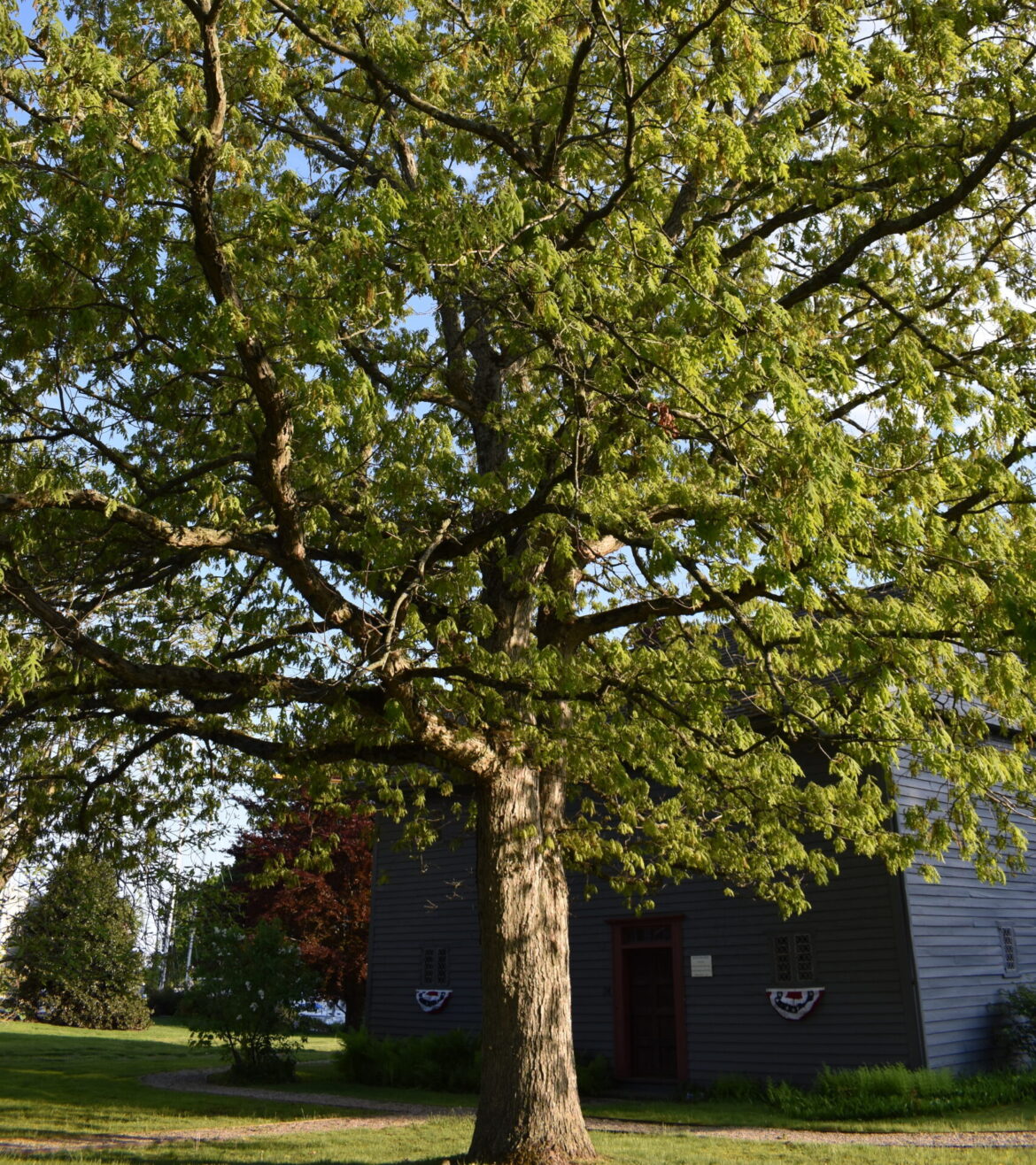
The tree known as the Charter Oak in Connecticut is a symbol of American independence, self-rule, and resistance to tyranny. The Milford Historical Society (MHS) obtained a descendant of the original Charter Oak tree, known as a scion, during the country’s Bicentennial celebration in 1776, and it now graces the MHS High Street lawn.
The original Charter Oak tree in Hartford, stood about 75 feet tall and with a circumference of between 20-30 feet, was estimated to be between 800 and 1,000 years old when it fell during a violent storm on August 21, 1856.
The legend of Connecticut’s Charter Oak goes back to 1662, when King Charles II granted a Royal Charter to the Connecticut colony, ensuring the right to self-govern. His successor, the next king, James II, wanted to consolidate colonies and sent Governor Edmund Andros to confiscate the charters.
Allegedly, when Connecticut colonists met with Andros at Sanford’s Tavern in Hartford on October 31, 1687 to return the charter, the candles were suddenly extinguished, and the document disappeared. As the story goes, Captain Joseph Wadsworth is said to have hidden the charter in the hollow of the nearby ancient white oak tree, thus preserving the colony’s self-governance.
After the tree fell, residents collected acorns to plant, and many Charter Oak descendants now grow throughout Connecticut, often gracing the lawns of parks, town greens, post offices, town halls, and cemeteries. Seedlings were distributed to mark occasions such as George Washington’s 200th birthday in 1932; the 300th anniversary of the charter in 1962, the new state constitution in 1965, and the Bicentennial in 1976. In 1935, a three-cent U.S. postage stamp depicted the tree, and in 1999, the Charter Oak was featured on the Connecticut state quarter.
—Katie Murphy