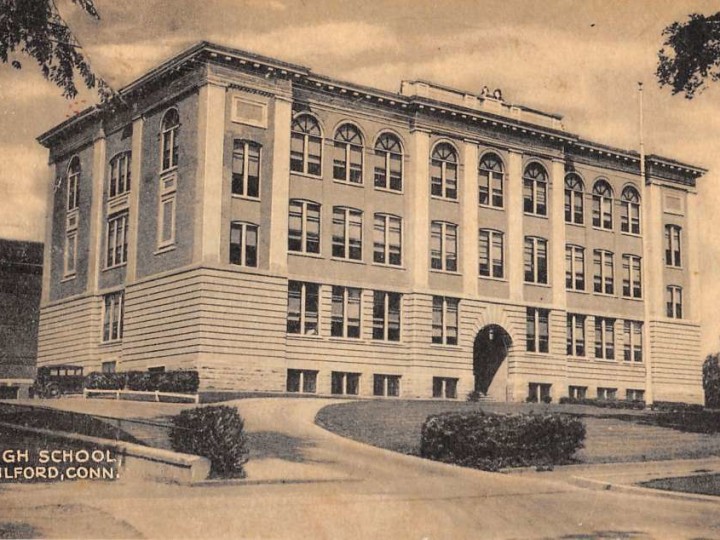

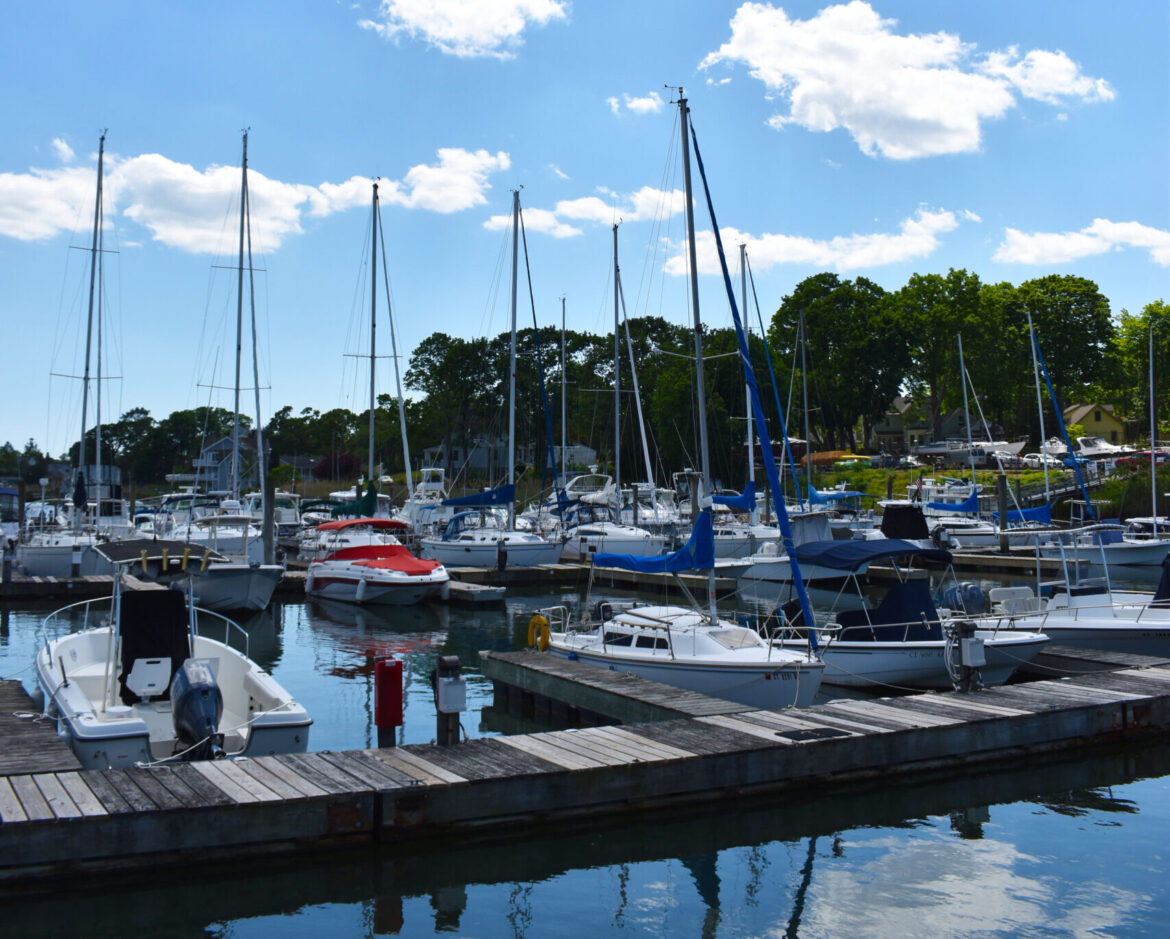
Milford Harbor, a well-protected area that accommodates a range of vessels, including recreational, commercial, federal, state, and local boats is part of a landscape that features more than 17 miles of shoreline along the Housatonic River and Long Island Sound.
The Paugussett tribe were the earliest known inhabitants of this land. Drawn to the fertile soil and rich coastline teaming with fish and shellfish, they named the navigable river that flows into the open sound “Wepawaug,” or the crossing place.
In the summer of 1637, Captain Thomas Tibbals and his militia appraised this site on the Wepawaug River, with excellent access to a deep harbor as an ideal location for a new settlement. Reverend Peter Prudden and “Free Planters” returned in 1639, purchased the land from the Paugussetts, and founded Milford.
The Founder’s decision to settle near the harbor would irrevocably shape Milford’s future, impacting the city’s future economic development, ecosystem, population, traditions, tourism, recreational opportunities, and daily life.
Early days
“An advantage to Milford, was that it had a steady supply of water for livestock to operate the first mill in New Haven Colony,” says Arthur Stowe, Milford’s city historian. “In 1640, William Fowler built the first mill, later adding a millrace to power a sawmill at Wharf Lane (now High Street). This linked the Green to the docks, becoming the main commercial street in town and the heart of activity. Before long, the mill was grinding corn, buckwheat, and rye into flour. Alexander and Richard Bryan became the first merchants trading and shipping animal skins along the east coast as far as the West Indies. To do this, they built large warehouses along Dock Road.”
As shipbuilding and commerce flourished, the harbor’s strategic location on the Sound became crucial for both defense and offensive operations during the Revolutionary War. Most notably, on New Years Eve, 1776, a British ship secretly disembarked 200 smallpox-ridden American POWS at the harbor before disappearing into the fog.
After the war, shipbuilding enterprises were established and, for a time, flourished. Maritime operations expanded throughout the Civil War, prompting changes to the harbor’s infrastructure. In 1874, the U.S. Army Corps completed initial navigational upgrades, improvements to the channel, anchorages, and jetties.
In the ensuing decades, the harbor and surrounding beach towns underwent several transformations, evolving into a manufacturing and oystering hub, a popular summer resort, and later a recreational boating and aquaculture center. The completion of I-95 in the 1960s made harbor access even easier.
Keeping up with Times
“Improvements have been made over the years,” says Jim Donegan, currently in his seventh year as Milford Harbor’s operations director and fourth year as harbor master. “Recently the Army Corps of Engineers dredged the mooring field and substantial portion of the Federal Navigation Channel. We removed, inspected, and replaced mooring hardware.
Donegan notes that “The City of Milford had the first approved Harbor Management Plan in the State of Connecticut. The original plan was approved by government agencies in 1989. The current plan is the fifth edition. Other improvements at Lisman Landing include a large, covered pavilion for marina and community events, walking paths along the harbor, and refurbished restrooms and showers used by transient boaters.”
Donegan oversees supervision of the harbor and waterways, works with the Harbor Commission to implement plans, evaluate potential problems, and establish frameworks to achieve maritime goals on a local, state, and federal level. The other city agency responsible for managing the harbor is Planning and Zoning. “Our Board reviews requirements, zoning and ‘upland development’ that can impact the harbor and shoreline,” explains city planner David Sulkis.
Planning becomes essential in the summer, when boating, events, tourism, and environmental concerns put additional pressure on harbor resources. “That’s when the harbor really comes alive,” says Donegan. “The marinas and the city’s mooring field fill up with boats, and Milford Landing welcomes a constant stream of visiting boaters to the downtown.”
Boating and Business
Tracy Bonosconi, president of the Downtown Milford Business Administration (DMBA) acknowledges that more than 30 businesses, from long-time establishments like Stonebridge, The Canvas Patch, and Archie Moore’s to newcomers like Sunshine Ceramics and Mermaid Books, “are primarily dependent upon the harbor. The summer crowd helps sustain them.”
Lisman Landing is a city-operated transient marina at the head of the harbor. “This summer, it will also be the sight of “some of our free Friday’s After Five concerts,” says Simon McDonald, director of membership and marketing for the Milford Regional Chamber of Commerce. “These events draw 300-700 people, benefiting many Chamber members.” The Landing’s 130 moorings are rented seasonally to visiting boaters overnight or by the hour for lunch or dinner.
Bruce Kuryla, the owner of Milford Boat Works, anticipates full occupancy of all 190 slips at his marina, as well as slips at Spencer’s Marina and Safe Harbor Port Milford. During the summer, he manages his marina, is a member of Milford’s Harbor Commission, and is serving his sixth consecutive term as Commodore of the Milford Yacht Club. “I’ve worked in this harbor since I was 15,” he shares. “From dawn to dusk, I’m either at the boatyard or Yacht Club, where I go back three generations. My dad, Bruce Sr., was the Harbormaster from 2012 until he passed in 2022.” Kurlya maintains that Milford Harbor “is the best in Connecticut. “It’s easy to get in and out of day or night from the channel, it’s protected and just the right size for recreational boaters.”
Milford Yacht Club general manager Theresa Phelan confirms that the harbor is a “central part of life” at the Yacht Club. “We’re at the mouth of the harbor, so for our members, it is an essential part of the experience,” says Phelan. “Even if you’re not a boat owner, our location offers a front-row seat to the constant flow of vessels creating a captivating backdrop.”
Milford resident Erin Hamel takes advantage of that front-row seat and unobstructed scenic view from her home on Hotchkiss Point. “Every day the harbor puts on a different face,” she says. Plus there is a deep family connection to the Harbor itself. “Our neighborhood, and the Hotchkiss Bridge connecting Fowler Field to Factory Lane, was named for my grandfather Albert “Al” Knox Hotchkiss, a lifelong Milford resident and engineer. He devoted his entire life to restoring the docks up until the age of 92.”
Fish Friendly
“Milford Harbor is a magic location when it comes to supporting marine life,” says Dr. Gary Wikfors, director of the NOAA Fisheries Milford Lab. “We’ve been able to conduct our research with shellfish for more than 90 years because of the excellent water quality. The Wepawaug River drainage basin is all residential and sewered, so there are minimal sources of pollution from the freshwater end of Milford Harbor. On the saltwater end, our location has the Long Island Sound central currents bringing us clean ocean water and protecting us from industrial input to our west and east.”
These conditions are favorable to both oyster farming and recreational fishing. (ital)The Fisherman Magazine suggests. “Swimming a live bait for bluefish, stripers, and weakfish on the east side of Milford Harbor.” You can also look for “schoolie stripers, snapper blues, and menhaden along tidal preserves.” And if you are on shore, “you’ll have a shot at blues, bass, flatfish, weakfish, and menhaden by casting from either side of the breakwalls at the harbor entrance.”
Protecting the People
All that water traffic and increased summer recreation requires more safety protocols that range across a host of city and private enterprises.
The Milford Recreation Department, in conjunction with the Coast Guard Auxiliary at Lisman Landing, offers boating safety and navigation courses.
The U.S. Coast Guard Auxiliary Milford Flotilla (spotlighted in our Spring issue), a non-profit volunteer organization, the promotes recreational boating safety, public education, and maritime support, conducts vessel safety checks, provides crews for search and rescue training, and supports community events.
The Milford Police Department Marine Patrol Unit consists of 15 officers, responding to emergencies such as boating incidents, missing persons, and medical situations. They enforce laws, conduct safety inspections, monitor infrastructure, and work with the Coast Guard. Their primary vessel is a 34’ North River Valor with advanced tech, plus a 19’ rigid hull inflatable boat.
The Milford Fire Department Marine Unit has a Response Team, with 13 certified divers, a 27′ steel-hull fireboat, a rescue boat (Marine 1 and 2), and jet ski. Their responsibilities include search and recovery, SONAR, storm response, medical emergency support, search and rescue/recovery, storm/flood response, stranded persons/vessels, maritime fires, mutual aid to other coastal towns, and countless other scenarios.
Milford Harbor is a living thing, never more so than at the height of summer with residents and visitors alike treading the dock boards and taking in picturesque views. “It is extremely important to preserve and maintain our harbor,” says Jim Donegan. “In 1639, Milford was an attractive settlement because of everything our coastline and harbor offered. Those characteristics still hold true today. Our harbor and waterways are a hub of activity that keep drawing people to Milford.”
-Cindy Papish Gerber